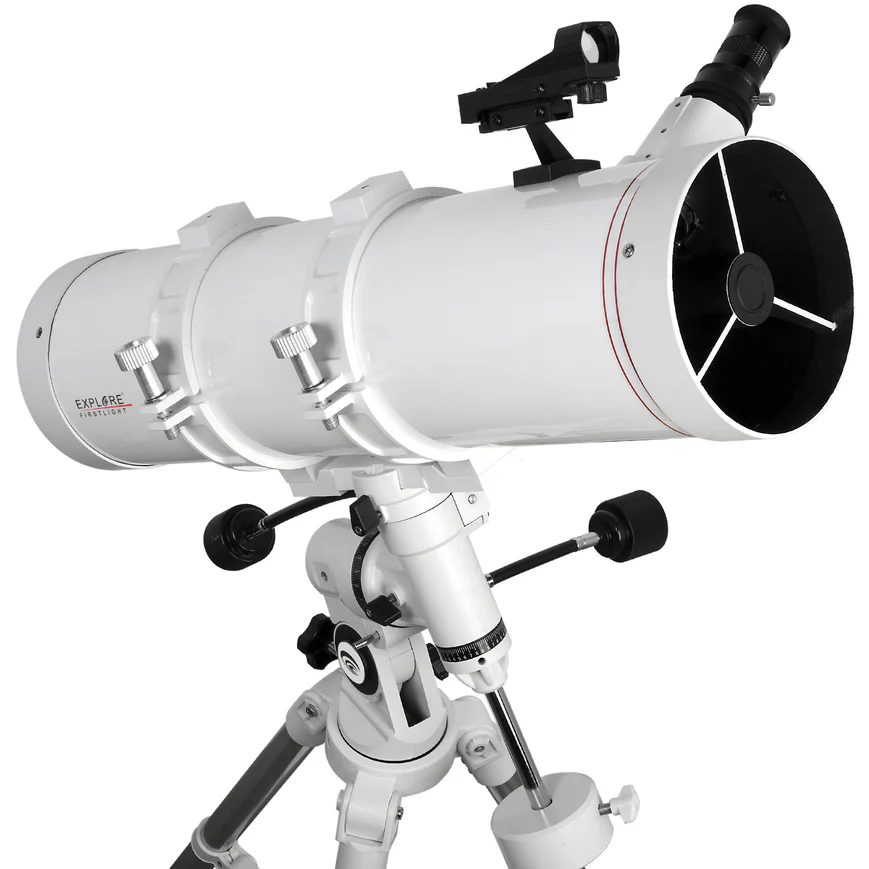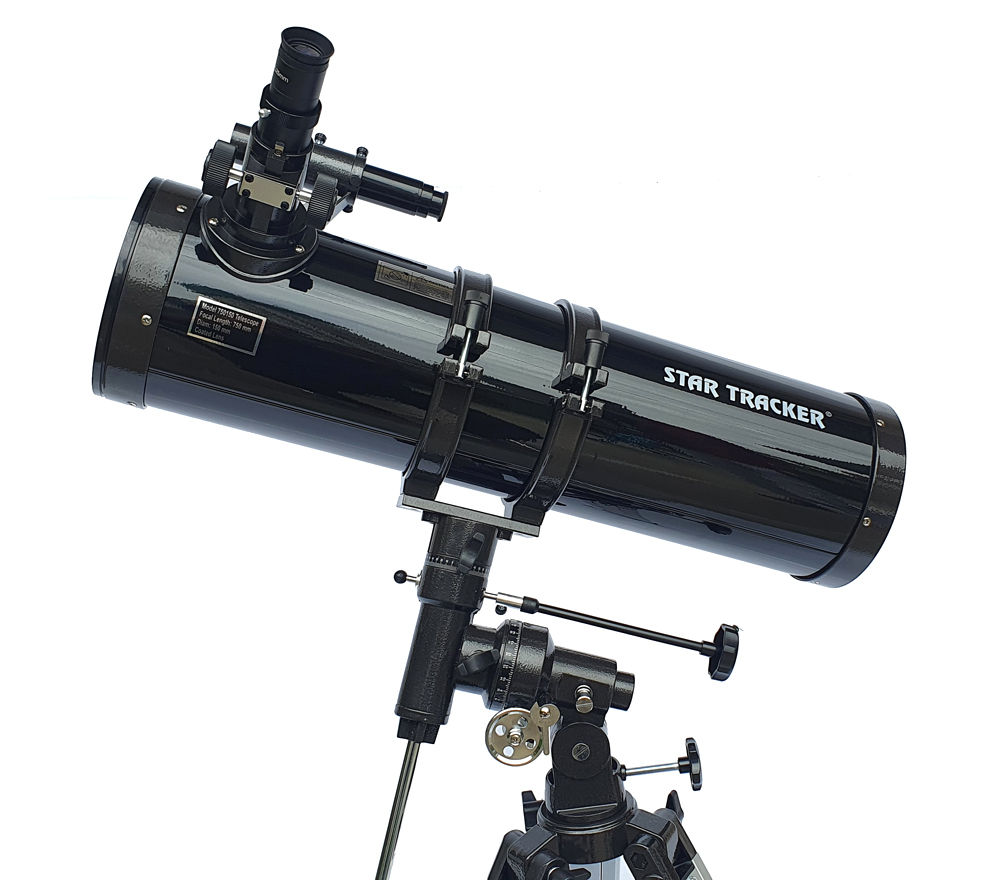

Startracker 150/750 EQ Reflector Telescope
If you have been stargazing for a while and want a telescope that genuinely rewards the effort, the StarTracker 150/750 is where things get interesting. With a 150mm primary mirror and a focal length of 750mm, this is a proper deep sky instrument that will show you objects a smaller telescope simply cannot reach.
The 150mm aperture collects significantly more light than the entry-level 70mm or 80mm refractors, which means galaxies, globular clusters, and emission nebulae start to look like the objects you have seen in photographs, not just faint smudges. The Hercules Cluster (M13) begins to resolve into individual stars. The Ring Nebula in Lyra shows its characteristic smoke-ring shape. Hundreds of Messier objects come within reach on a clear night.
The focal ratio of f/5 gives you a wide, generous field of view at lower magnifications, making it a pleasure to sweep through the Milky Way or frame large objects like the Andromeda Galaxy. The included 25mm Plossl eyepiece delivers roughly 30x with a true field close to 2 degrees, which is about four times the apparent diameter of the full moon. That is real sky coverage. The 6.5mm eyepiece pushes up to 115x for planetary and lunar work, and the 2x Barlow lens extends the range further to 230x when the atmosphere cooperates.
The Newtonian optical design uses no correction lenses in the light path, so contrast on the moon and planets is excellent. Craters, mountain ranges, and terminator detail come through cleanly at high power.
The mount is a heavy-duty EQ-III (EQ2) equatorial, with slow-motion controls on both RA and DEC axes. Once polar-aligned, tracking an object manually becomes smooth and deliberate rather than a constant battle. It is also a solid foundation for basic lunar and planetary photography with a phone adapter.
What you can realistically observe with this telescope: Moon, Saturn's rings and Cassini Division, Jupiter's cloud bands and the four Galilean moons, Mars surface markings near opposition, double stars, open and globular clusters, the brighter galaxies (M31, M81, M82, M51 in good skies), and planetary nebulae.
Not sure if this is the right telescope for you? We are happy to help you decide. Chat with us on WhatsApp before you buy.